


Your in-depth guide on how to adjust a cake recipe easily so that you can use the cake pans/tins you have without having to go and buy a pan that you may only use once.

Jump to:
- What do you do when you don't have the right cake pan?
- How To Adjust A Recipe For Any Cake Pan/Tin
- List Of Surface Areas For Different Cake Tin Sizes
- Example of adjusting a recipe:
- Step-by-step guide:
- Quick Guidelines (Important Baking Notes)
- FAQ's
- What About Baking Powder and Eggs?!
- Do I Have To Do The Math?
- CAKE RECIPES TO TRY THIS MATH ON:
What do you do when you don't have the right cake pan?
I’ve been there before… I’ve gone to make a recipe only to realise that I don’t have the 9 inch cake pan that the recipe calls for. Dang. I take a gamble and hope that my smaller 7 inch cake pan will suffice.
Suddenly the baking time no longer applies and I have no idea how long to bake it for. I’m constantly opening the oven door checking if the cake is done.
Worried, I take the cake out of the oven hoping and praying it will be cooked all the way through. To my horror, the cake has over flowed as there was way too much batter in the cake tin and the middle is not cooked at all. Oh dear, the cake tin really was far too small…#disaster.
Has this ever happened to you? Maybe it has and is what has brought you here today. If so, welcome friend. I am here to provide all of the answers you need relating to how to adjust cake pans for any recipe (easily).
How To Adjust A Recipe For Any Cake Pan/Tin
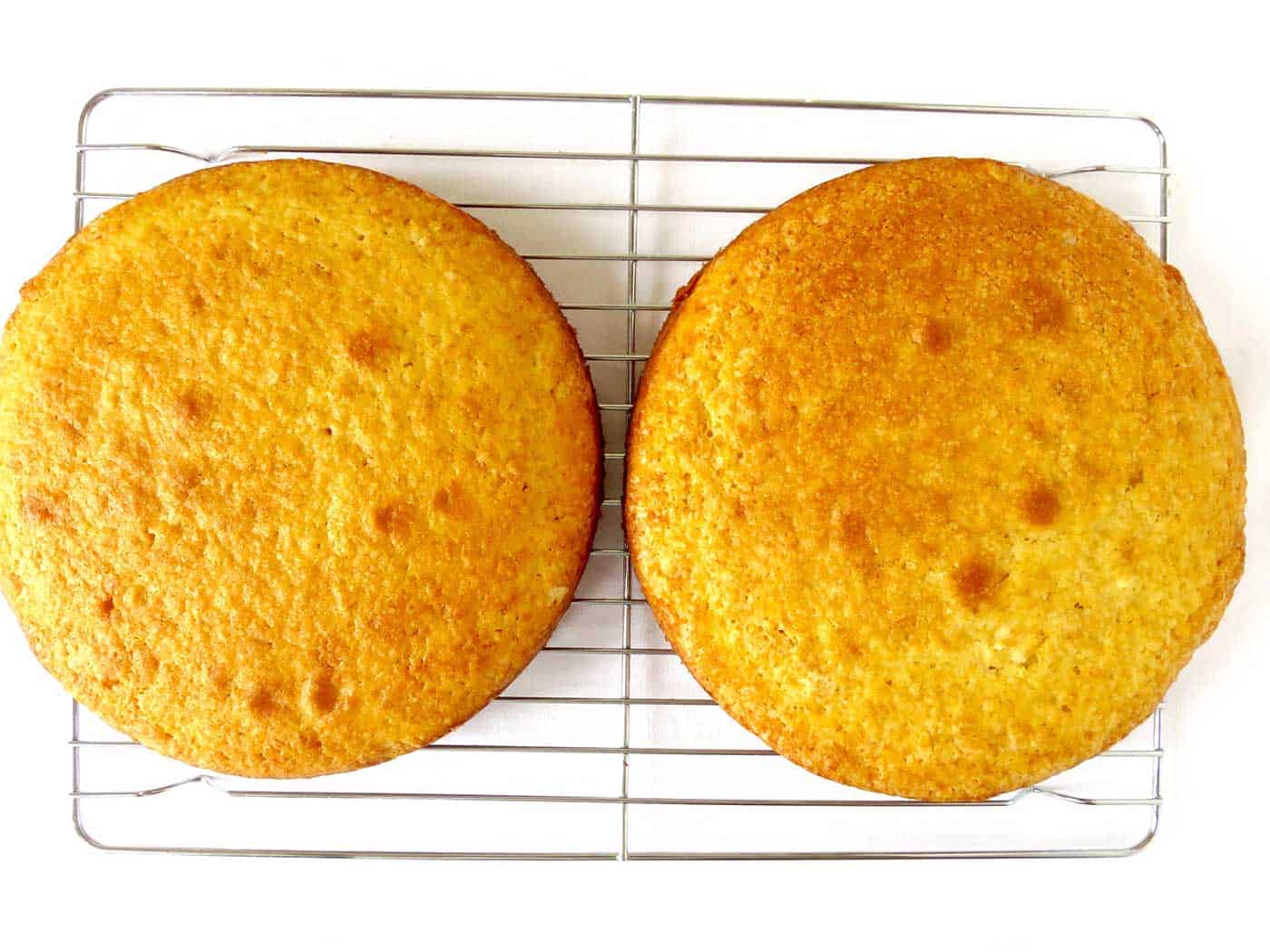
When I first started my Cakery I converted all of my recipes to fit several different sized cake tins as I offered 6”, 8”, 10” and 12” cake sizes in my menu. This ensured that each cake flavour, despite the size, was exactly the same texture, height and consistency as my base recipes. Knowing the maths for this was a game changer and thankfully I didn’t have to do too much of the maths as Food 52’s article by Alice Medrich had done all of the prep work for me.
All you need to know is the surface area of your tin/pan (by using the simple math or chart below).
(I stick to inches for this to make it easier, I recommend converting your cake tin sizes into inches first).
To work out the surface area of a rectangle/square cake tin, multiply one side by the other. E.g. for a 6” square cake tin 6 x 6 = 36 therefore the surface area of a 6” square cake tin is 36 square inches. Simple right?
For round cake tins, it gets slightly more complicated but still within my limited math capabilities (thank goodness).
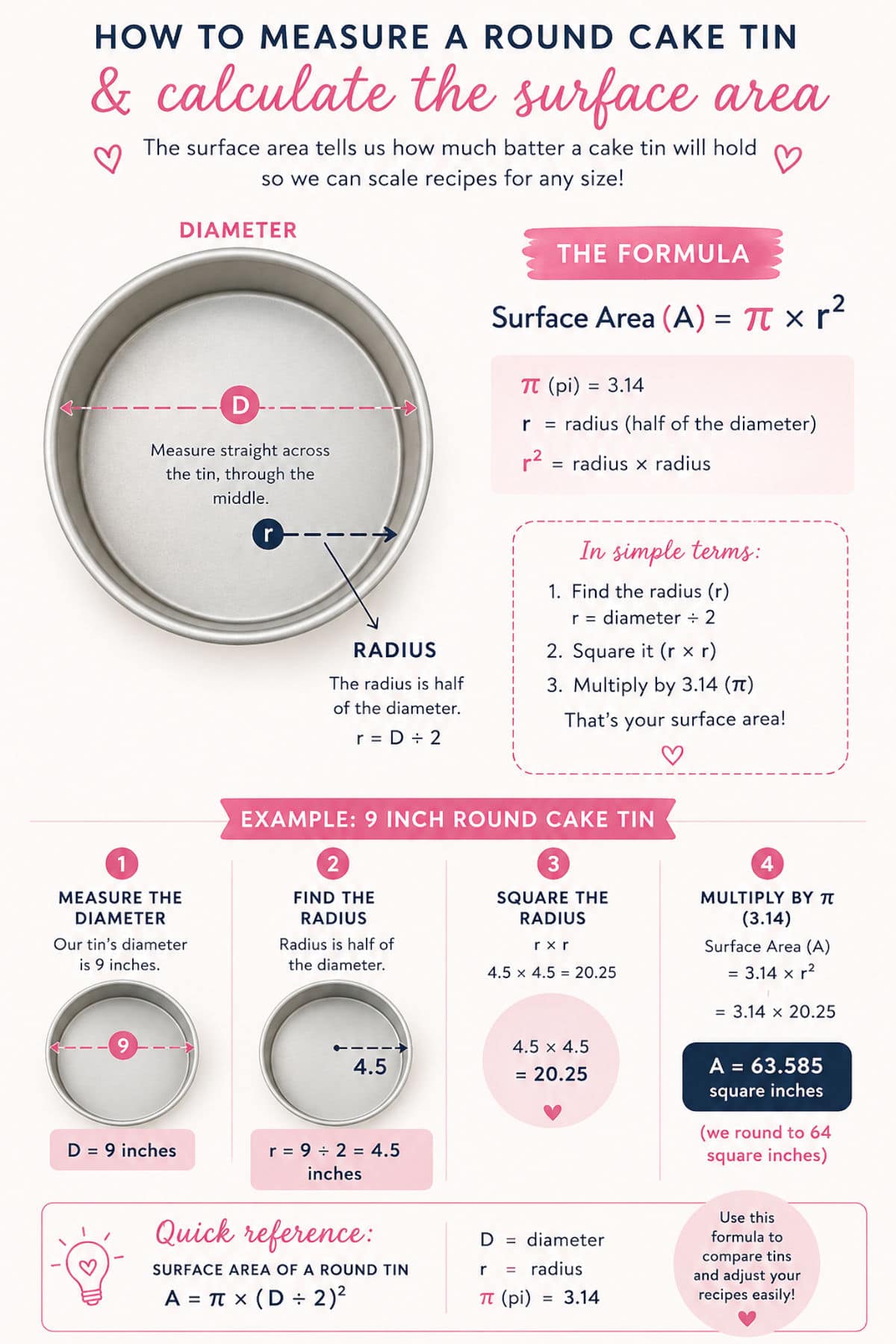
To work it out, multiply π (which is 3.14) by radius squared (I had to ask my husband to remind me that the radius is half a diameter). So if we’re trying to workout the surface area of a 9” round cake tin we multiply 3.14 (π ) by 4.5 (because 4.5 is half of 9) and again by 4.5 which equals 63.585. This is a messy number in which we can just round to 64.
If you're like me and math isn’t your thing, this diagram makes it much easier to visualise:
List Of Surface Areas For Different Cake Tin Sizes
For your reference, here is a list of surface areas from commonly used cake tins:
THE SURFACE AREA OF ROUND CAKE TINS:
- 5 inch = 20 square inches
- 6 inch = 29 square inches
- 7 inch = 39 square inches
- 8 inch = 50 square inches
- 9 inch = 64 square inches
- 10 inch = 79 square inches
- 12 inch = 113 square inches
THE SURFACE AREA OF SQUARE/RECTANGLE CAKE TINS:
- 6 x 6 = 36 square inches
- 7 x 7 = 49 square inches
- 8 x 8 = 64 square inches
- 9 x 9 = 81 square inches
- 9 x 13 = 117 square inches
- 12 x 16 (half-sheet pan) = 192 square inches
THE SURFACE AREA OF LOAF PANS:
- 8 × 4 = 32 square inches
- 9 × 5 = 45 square inches
As you can see, the surface area helps make clear just how much bigger or smaller one cake tin can be from the next. Hence why my 7” cake pan didn’t hold up to the 9” cake recipe too well.
Knowing the math now, we can figure out how to adapt the 9” cake recipe for my 7” cake tin.
All we need to do is divide the 9” surface area by the 7” cake tin surface area:
64 (surface area of 9” cake tin) divided by 39 (surface area of 7”) = 1.64. Thus, divide all ingredients of 9” cake recipe by 1.64.
You will need the recipe to be in grams for this to work effectively (I’m always going on about how important it is to weigh ingredients over using volume to measure (e.g. with cups).
If you can’t be bothered working out the math yourself (I get it!!) and I have found a recipe converter that does this step for you. Check out Bakevert Baking Pan Converter
Example of adjusting a recipe:
Here’s an example of how I converted my cake recipes to fit many different size cake tins:
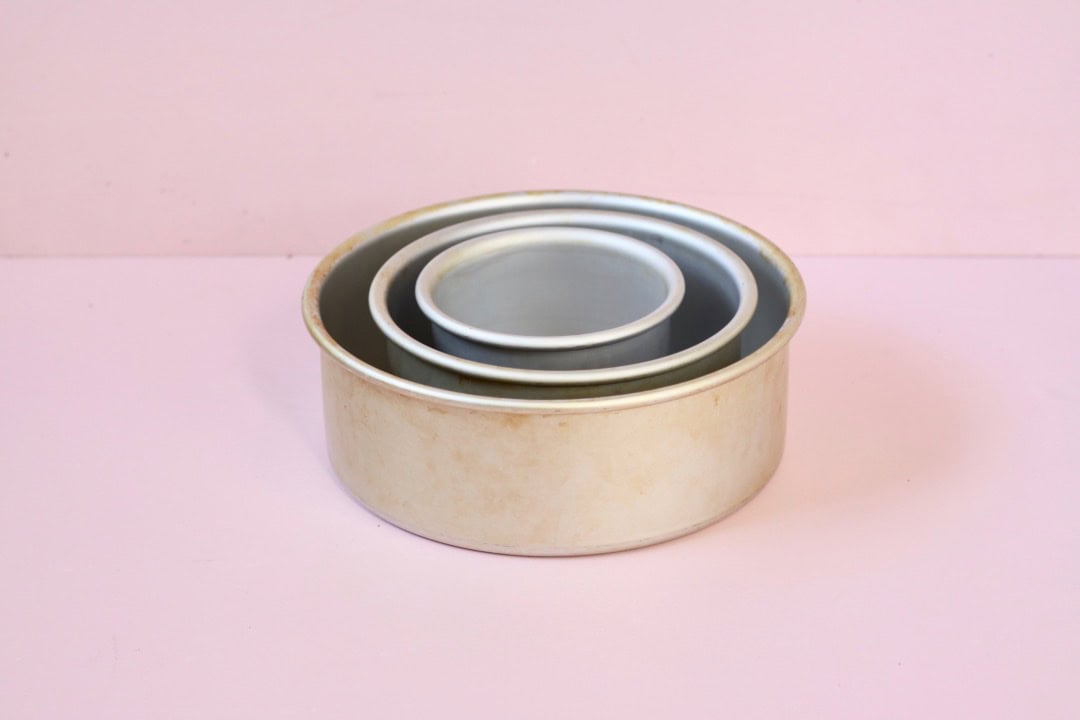
My recipe was for a two layer 9” cake and I wanted to use my two of my 7” cake tins (note, not all ingredients are shown in this sample):
| INGREDIENTS | 9” (Divide 9” ingredients by 1.64) | 7” (ingredients after dividing by 1.64) |
|---|---|---|
| Flour | 295g | 180g |
| Brown Sugar | 406g | 247.50g |
| Oil | 276.92g | 168.75g |
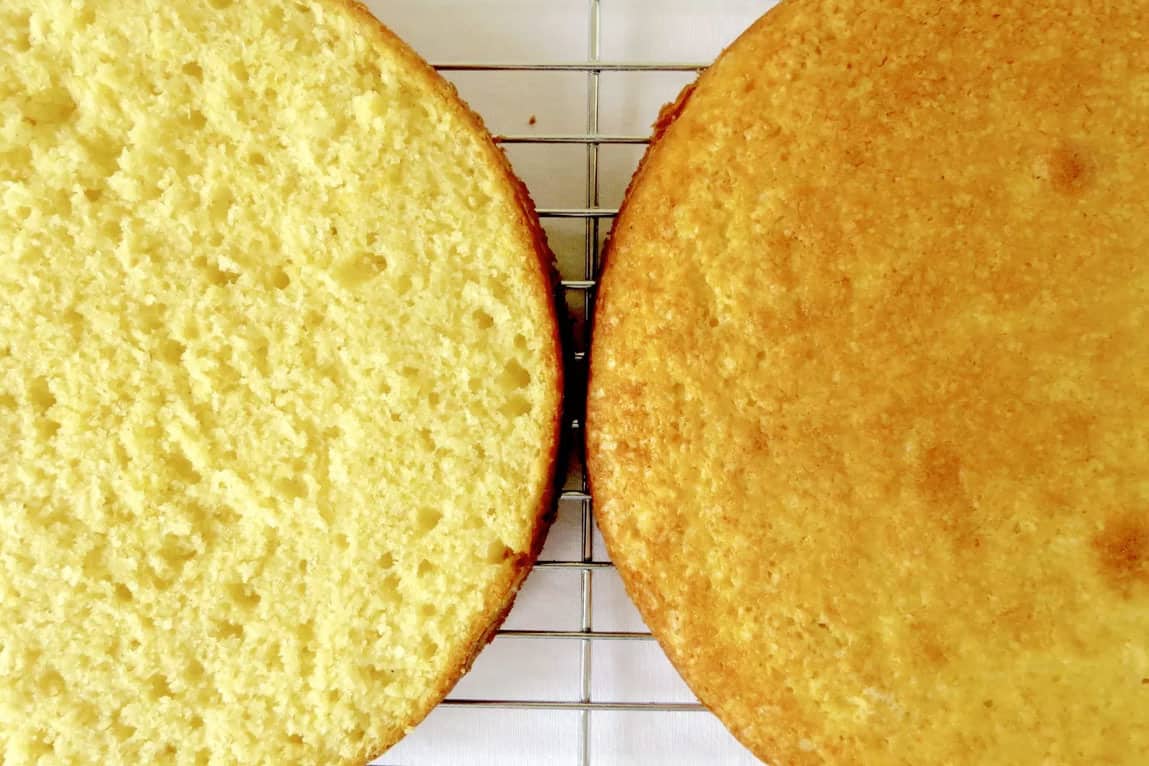
After dividing all ingredients by 1.64 (as shown by the math above), I was able to bake the cake in my 7″ cake pans which produced the same height, texture and consistency as my 9″ cake pans. Success!
If the recipe had been for a 7” cake tin but I only had a 9” cake tin, then I would have multiplied the 7” ingredients by 1.64 to get correct measurements for a 9” cake tin.
Step-by-step guide:
If you don’t have the right cake tin, here’s how to adapt your recipe correctly instead of guessing.
- Measure the surface area of your cake tin (or use a conversion chart)
- Compare it to the tin size the recipe was written for
- Divide the recipe’s surface area by your tin’s surface area to find the conversion factor
- Divide all ingredients by that number if your tin is smaller
- Multiply all ingredients by that number if your tin is larger
- Ensure all ingredients are weighed in grams for accuracy
- Adjust baking time as needed and check for doneness with a skewer rather than relying only on the recipe time
Quick Guidelines (Important Baking Notes)
- Fill cake tins no more than ⅔ full if you are unsure
- Baking times will change with tin size - always check early
- Baking powder, salt, and vanilla can be rounded slightly for practicality
- Use 50g per egg as a standard reference for scaling recipes
FAQ's
Yes, but the cake may bake unevenly or overflow if the pan size is too different. You also may not have enough batter or too much batter.
Yes. Smaller/deeper pans usually need longer baking times, while larger/shallow pans bake faster.
Usually yes. Cupcakes typically bake at the same temperature but require a shorter baking time. I turned my Popular Chocolate Cake into these Decadent Chocolate Cupcakes. Have a look at both recipes to compare sizing and bake times.
What About Baking Powder and Eggs?!
For ingredients like baking powder, salt, vanilla extract etc. I round up or down the nearest half or quarter e.g. if 1.5 teaspoons of baking powder is needed for 9” cake recipe I round 1.64 down to 1.5 and use 1 teaspoon of baking powder.
Another helpful trick is to follow the rule one teaspoon baking powder per cup of flour and ¼ teaspoon baking soda per cup of flour.
Salt and vanilla are little more easier to play around with seeing as they are flavour enhancers only and don’t affect the structure of the cake.
For eggs – work off of a standard egg weighing 50g (out of the shell). If you only need 25 grams of an egg, crack an egg into a cup whisk and measure out 25g using scales. Save the leftovers for brushing over pastry or use for scrambled eggs.
Do I Have To Do The Math?
If this all seems like too much hard work, I get it! If you are using a smaller cake tin than what the recipe states, you could just make the recipe as usual and follow the general rule of thumb which is to fill the cake tin ⅔’s full.
Any left over cake mixture can be used for mini cupcakes to be frozen and used for another time. In the opposite scenario (the cake tin you have is larger than the required in the recipe), then you could multiply the recipe by 1.5 or 2 depending on how much larger the cake tin is. But in fairness, if you’re going to do some math anyway you may as well do it precisely and get it right with the method above.




Thank you so much! This is very helpful, but what about liquids? How to convert mls?
You're so welcome! Liquids are converted the same way as other ingredients. Simply multiply or divide the mls by the same amount as the rest of your recipe. For example, 250 ml becomes 500 ml when doubling a recipe. If your recipe measures the liquids by volume, convert it to mls first. I hope this helps 🙂
Hello Sarah. And thank you for such a thorough article. I have a recipe that makes three 6-inch rounds. If I follow your method, does that mean the batter will fit three 8” rounds, three 10” rounds, etc? I’m so wary of making a mistake.
Hi! You're so welcome, I'm glad you found the article helpful. Yes, exactly! You can use the method to calculate how much batter you'll need for three 8-inch tins, three 10-inch tins, and so on, while keeping the layers a similar height.
Just remember that the baking time will change, so keep an eye on your cakes and test with a skewer.
I completely understand being wary of getting it wrong! I'd recommend weighing your ingredients in grams for the most accurate results. Once you've done the calculations, you'll have the right quantities for your new tin size without having to guess. Happy baking! 😊 Let me know how you get on!x